


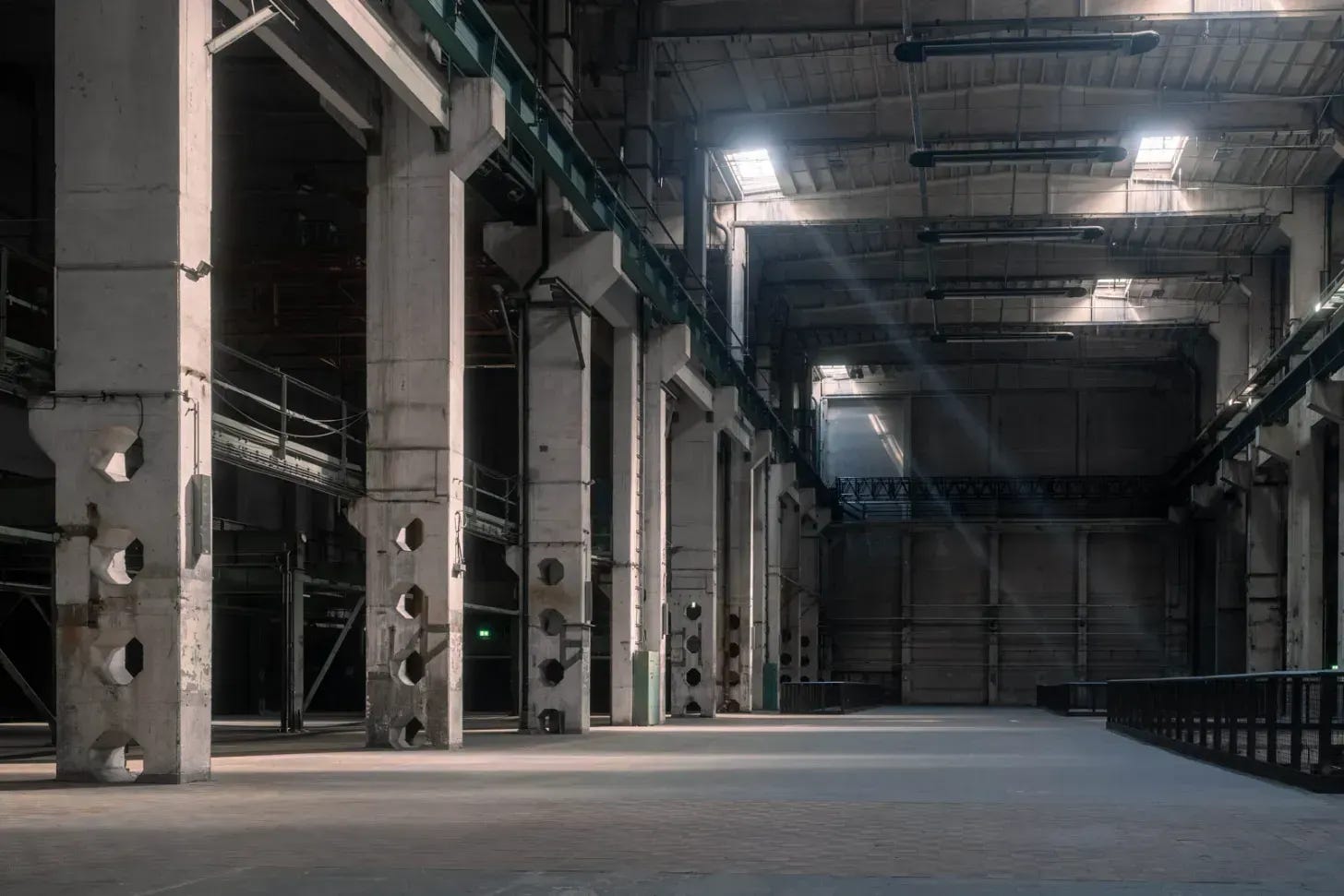
SEARCHING FOR THE PERFECT SOUND – THE QUIET SPACE
Kraftwerk Berlin, a sacred space of its own.
– It’s a Saturday, and I’m writing. At first, I’m sitting in a café just around the corner from me in Prenzlauer Berg. It’s getting cold. I need to grab something to wear and then I want to keep writing. But spend money on another coffee? Actually, I’m just looking for a quiet place to think.
While I’m still wondering where I might find such a place, I decide to take care of the practical matters first: Picking up my bike from a friend in Kreuzberg. I’ll find the right spot afterward.
I ride to Heinrich-Heine-Straße and walk past the Kraftwerk when a woman passes me and turns into the Kraftwerk’s garden. I stop for a moment and think: I’ll probably have to pay again. Still, I look at the poster and read the information.
THE QUIET SPACE TUE – SUN 3:00 PM – 8:00 PM FREE ADMISSION
It’s 3:01 PM, in front of the cogeneration plant that was shut down in 1996. I walk toward the entrance door, which opens at that very moment. I don’t need a ticket, nor do I have to wait in line. I’m told that this is a quiet, analog space and that it would be better not to use my phone. I write all my texts on paper with a pencil anyway.
I go inside. I walk up the stairs to the second level. I’m the only one here so far.
On the other side of the room, where artists perform during events, there are a few benches.
So I’ve found my quiet spot. I breathe in. I breathe out. And I begin to write:
Concrete, steel, hard surfaces in a very large space, several thousand square meters in area—a soundscape that’s more reminiscent of a cathedral…
What I usually know as a space filled with sound is empty today. Completely empty.
The huge turbine hall, as a hollow structure, absorbs the sounds of people, sets them in motion, and allows their resonance to grow. This is how it develops its own sonic character. The resonating body is the heart of many musical instruments—and also of this power plant. Its construction, materials, and volume significantly shape its specific sound.
A motorcycle roars down the street; inside, the roar echoes along with it—though much later. The power plant doesn’t need music to be a space of sound. Sonically, the place is like a fellow performer or, in this case, another visitor. So much is happening acoustically.
You begin to hear the space:
The ventilation system, distant footsteps, a faint hum, your own breathing, the reverberation of the tiniest sounds.
The silence isn’t empty.
The hum of electricity, a small click here, a loud clack there, a metal post gets bumped, one whispers softly, the other makes itself heard loudly, a door in the lower belly of the hall slams shut and lingers in the air for a long time, only falling with difficulty. My pencil on the paper isn’t a private event—it’s conveyed through the air. Something thuds—perhaps a metal door—on the left, while the toilet flushes on the right. Nothing happens in isolation; everything blends into a single whole. More human bodies fill the space, more shoe soles on the same floor, fabrics rustle against one another. It becomes a rhythm. The space speaks back. The silence listens. And responds.
And whatever happens outside is swallowed up by the empty space of the imposing turbine hall that is about 100 meters long, with a ceiling height of 20 to 27 meters, and a total area of over 8,000 m² spread across multiple levels.
Everything echoes here.
No matter what sound is set in motion in this space, it begins to vibrate; the hall becomes an instrument.
Let’s stay a little longer, I whisper to myself.
Thanks to the calming effect of the diffuse sound that envelops the body—rather than stimulating it, as is usually the case, with direct, powerful waves—this visit makes the experience more of a mental one than the typically physical one.
The Quiet Space.
Is silence the perfect sound?
All info about THE QUIET SPACE HERE.

DEUTSCHE VERSION:
SEARCHING FOR THE PERFECT SOUND – THE QUIET SPACE (KRAFTWERK BERLIN).
Das Kraftwerk Berlin, ein eigener sakraler Raum
– Es ist ein Samstag, an dem ich schreibe. Zuerst sitze ich in einem Café, bei mir um die Ecke, im Prenzlauer Berg. Es wird kalt. Ich muss mir etwas zum Anziehen holen und will danach weiterschreiben. Aber schon wieder Geld für einen Kaffee ausgeben? Eigentlich suche ich nur einen ruhigen Ort zum Nachdenken.
Während ich noch überlege, wo ich diesen Ort finden könnte, entscheide ich mich, zuerst das Praktische zu erledigen: Mein Fahrrad in Kreuzberg bei einer Freundin abzuholen. Der Ort wird sich danach schon finden.
Ich fahre zur Heinrich-Heine-Straße und laufe am Kraftwerk vorbei, als mich eine Frau passiert und in den Garten des Kraftwerks einbiegt. Ich bleibe kurz stehen und denke: Muss ich bestimmt wieder zahlen. Trotzdem schaue ich mir das Plakat an und lese die Informationen.
THE QUIET SPACE
TUE – SUN
15:00 – 20:00
FREE ADMISSION
Es ist 15:01 Uhr, vor dem 1996 stillgelegten Heizkraftwerk. Ich laufe auf die Eingangstür zu, die sich genau in diesem Moment öffnet. Ich brauche weder ein Ticket, noch muss ich anstehen. Man weist mich darauf hin, dass dies ein ruhiger, analoger Ort sei und es besser wäre, das Telefon nicht zu benutzen. Ich schreibe ohnehin alle meine Texte zuerst mit einem Bleistift auf Papier.
Ich gehe hinein. Ich laufe die Treppen zur zweiten Ebene hinauf. Ich bin die Einzige, bisher.
Auf der anderen Seite des Raumes, dort, wo bei Veranstaltungen Künstler spielen, stehen einige Bänke.
Damit habe ich meinen ruhigen Ort gefunden. Ich atme ein. Ich atme aus. Und fange an zu schreiben:
Beton, Stahl, harte Oberflächen in einem sehr großen Volumen, mehrere tausend Quadratmeter Fläche – ein Klangbild, das eher an eine Kathedrale erinnert…
Was ich sonst als klanggefüllten Raum kenne, ist heute leer. Komplett leer. Die riesige Turbinenhalle als Hohlkörper nimmt die Töne der Menschen auf, versetzt sie in Schwingung und lässt ihre Resonanz anwachsen. So entsteht ihr eigener Klangcharakter. Der Resonanzkörper ist das Herzstück vieler Musikinstrumente – und auch dieses Kraftwerks. Bauweise, Material und Volumen prägen seinen spezifischen Klang maßgeblich.
Ein Motorrad rauscht auf der Straße, drinnen rauscht es mit. Jedoch viel später. Das Kraftwerk braucht keine Musik, um Klangraum zu sein. Klanglich ist das Ding wie ein Mitspieler. Oder ein weiterer Besucher, in dem Falle. Es passiert so viel akustisch.
Man beginnt, den Raum zu hören:
Das Lüftungssystem, entfernte Schritt, ein leises Summen, das eigene Atmen, den Nachhall kleinster Geräusche.
Die Stille ist nicht leer.
Summen von Elektrizität, ein kleines Klicken hier, ein großes Klacken da, ein Metall Pfahl wird angerempelt, der eine flüstert leise, der andere zeigt sich laut, eine Tür im Unterbauch der Halle fällt zu und bleibt lange in der Luft stehen, fällt nur schwer ab. Mein Bleistift auf dem Papier bleibt kein privates Ereignis, es wird durch die Luft mitgeteilt. Etwas rumpst, vielleicht eine Metalltür, auf der linken Seite, während die Toilette spült, auf der rechten. Nichts passiert isoliert, alles vermischt sich zu einem großen Ganzen. Mehr Menschenkörper füllen den Raum, mehr Schuhsolen auf gleichem Belag, Klamottenstoffe rascheln aneinander. Es wird zu einem Rhythmus. Der Raum spricht zurück. Die Stille hört zu. Und antwortet.
Und das, was draußen passiert, verschlingt der leere Körper der imposanten, rund 100 Meter langen, Turbinenhalle mit einer Deckenhöhe von bis zu 20 bis 27 Metern und einer Gesamtfläche von über 8.000 m² auf mehreren Ebenen hohen Halle. Alles verhallt hier.
Egal, was in diesem Raum klanglich angestoßen wird, es gerät in Schwingung, die Halle wird zum Instrument.
Verweile noch, flüstere ich mir zu.
Durch die beruhigende Wirkung des diffusen Klangs, der den Körper umhüllt, statt ihn – wie sonst – mit direkten und druckvollen Wellen zu aktivieren, macht dieser Besuch die Erfahrung eher zu einer geistigen als zu einer sonst so körperlichen.
The Quiet Space.
Ist die Stille der perfekte Sound?
Searching for the Perfect Sound is a weekly column by me, Sophie Kübler, here on NSNS Magazine. As a sound engineer and sound artist, my life revolves around sound, day in, day out. My thoughts and statements are therefore based on sound.
I’m on the lookout for objects that might produce the perfect sound. I explore places and spaces where the perfect sound might be found or heard. I have conversations with artists and creative people who, in their own unique way, come very close to this idea – or at least never stop searching for it. And I experiment myself every day.
What interests me most of all is the philosophy of listening and discovery.
BEFORE YOU GO: No donation is too small when it comes to independent projects like this one.
At the only cost of a subscription on Substack you’ll get industry insights, articles, talks with professionals and more for.More articles on our website.
NSNS on INSTAGRAM

NSNS (short NEVER STOP NEVER STOPPING)
We present NSNS a digital platform for cultural and artistic exploration of human condition, rooted in a Latin America-based collaborative network.
if there are typos in here, it’s part of the charm, the newsletter is free. You can read more articles on the website where we get into much more detail with artists in sound, music and other creative disciplines.