



Photo: Martin Parr
In a city like London, millions of lives collide every day, everywhere, at all times, producing noise. But not just lives. Standing on the street or by an open window, you’ll hear sirens, bus brakes, motorcycles, the subway underneath you, bike bells, footsteps, people on phones, music from boomboxes or bass-heavy car sound systems. There are construction sites, trains... Big Ben.
But before you keep reading: this publication and text is all written out of love, interest and joy. No money, no sponsors, all organic and original. Please consider subscribing to the channel, to make use of the algorithm or to donate a buck.
When I wrote down the above list, one thing became clear: there is an enormous underlying network of the human condition connecting the cacophony of London. The bike isn’t just coming out of nowhere. The bike bell lines itself up in the overcrowded frequency spectrum of the city because someone on that bike rings it. The bus brakes come from a driver who applies the brake. The group in the Pub is energetically and euphorically filling the space with loads of conversations.
An angry person on the phone might be going through a break-up and screaming from pain, while the loud laughter of a woman might be the first real, big laugh she has had in a long time. The girls on the bus talking loudly and giggling might be on their very first trip through Europe after finishing high school. The street vendor at market is talking enthusiastically because he’s just become a father the day before. Behind every sound is so much more. People. Millions of them doing their own thing, whatever that might be.
None of these sounds necessarily belong together, but together they compose the sound of London and, through that, its plurality. And plurality isn’t always harmonious.
Referring to the many, but very similar, descriptions of cacophony, Merriam-Webster defines it as a harsh or jarring sound, as dissonance, and specifically as harshness in the sound of words or phrases.
But who gets to decide what is noise and what isn’t?
A church bell, a construction drill, a bus engine, a street musician, a protest, a teenager playing music from a speaker, or a market vendor shouting prices can occupy the same frequency spectrum, yet we judge them very differently. Some sounds are accepted as necessary parts of the city, while others are quickly described as noise.
That judgement also depends on the listener. Borough Market might sound alive and exciting to one person and exhausting to another. Someone living next to a railway for twenty years might barely notice the trains anymore, while a visitor hears every one of them. So the sound of the city is not only produced by what is happening around us, but also by attention, memory, familiarity and expectation.
I think of Dalston Junction Market. There are so many people there every day, speaking all kinds of languages, but not just verbal languages. There is the way vendors offer their products, approaching people and calling out prices loudly. Food sizzles on the grills. A large piece of cloth hits a plastic table as a vendor unpacks his products.
Or we go to Liverpool Street Station. Endless cars, the chaos of motors starting and stopping, honking, buses, more honking, people talking on phones. It is so crowded, everything is moving: a mess, a mass.
Or the crowds of Borough Market on a Sunday.
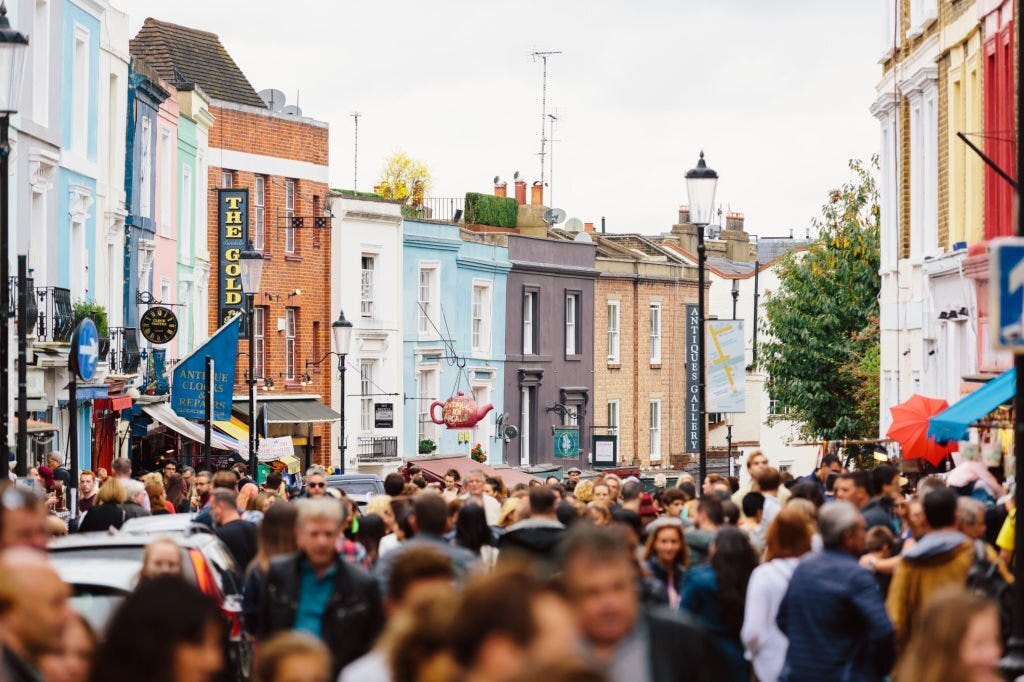
I am not too familiar with all parts of London, to name too many other areas and their characteristics. But here comes my point:
Cacophony is a representation of the frequencies and sounds of cultures and of the human condition: London which is multicultural, crowded, fast, in constant movement and held together by tight infrastructure. And everything overlaps: people, ambitions, backgrounds, emotional states, current appointments, vehicles, city structures, memory, belief, desire, traffic, all of it.
I am tempted to call it ambience, as we use the term in post-production, but is ambience the same thing as cacophony? I would argue that it is not, because cacophony entails a much richer, more real—or realistic—and, at times, viscerally annoying, harsh and crowded sound-body.
Perhaps ambience describes the sonic environment, while cacophony describes the relationship between the sounds within it. An ambience can be continuous, spacious and remain in the background with a few signature sound here and there. Cacophony on the other hand happens when sounds collide, interrupt one another and compete for space.
The sound of London is not merely noise produced by infrastructure. It is the audible overlap of millions of individual lives.
Is cacophony the perfect sound?
Searching for the Perfect Sound is a weekly column by Sophie Kübler, here on NSNS Magazine. As a sound engineer and sound artist, my life revolves around sound, day in, day out. My thoughts and statements are therefore based on sound.