


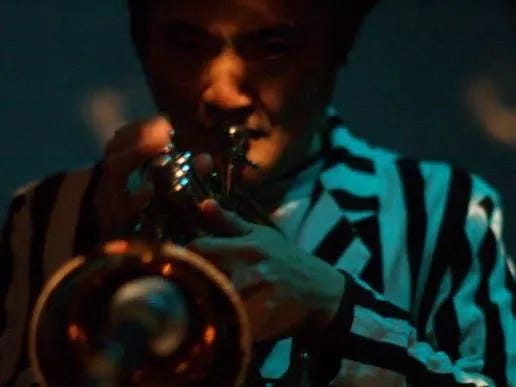
Image: Takuya Nakamura (@spacetakuya) • Facebook
Like many others, I know Takuya Kakamura through his show on The Lot Radio and the video with 1,6 million views, which one day a friend showed me. Was he a viral hit? I didn’t know but was intrigued and I am a fan of the live instrument. The opportunity to see him perform was a no-brainer, I was intrigued by the big number on the screen.
It is Wednesday early evening. It is summer in Berlin, the city feels like it is improvising, sounds in the air. Heinrich-Heine-Strasse, Tresor, Büro Siebzig, the line at the entrance is long and the club is already packed. When heading to the bar, I can hear a New York accent, French, Italien, Turkish, a properly cosmopolitan crowd.
It seems that a lot of people have caught wind of Takuya’s performance here and want to see him. I make my way to the front row. I see a microphone, CDJs, an OP-1, an OP-Z, turntables and a trumpet.
He started by talking to us like an MC. Then the jungle, dub, and techno beats get everyone moving first with the beats then with the trumpet. I warp into the musical world of Takuya Nakamura one track after another.
Throughout the night I will often have the impression that he is improvising, searching for the beats, looking for an entry point for new ideas. Sometimes he finds it immediately, sometimes it takes a little longer. But that is the exciting part: you follow him the whole time into his work, his rhythm. I mean this without judgment: he does not always hit the beat. For a brief moment, I also lose my footing as a listener. But exactly because of that, I start listening attentively again.
I think this is something I experience less and less in electronic music culture.
While watching him, I have to think about how rarely I see moments like this anymore. Especially in electronic music, so much is designed so that nothing slips out of place. Beats sit on the grid, transitions work, everything is prepared.
With Nakamura, suddenly there was someone in front of me who is so technically skilled that he dares to take risks. The entirety of his education, his knowledge, his toolbox in his head, traveling through his hands and lungs to the listener. And in the middle of all those techno beats, the trumpet becomes a pillar. I wanted it to be there, it was a refreshing human voice. The trumpet felt like a welcome return to something physical and human within the digital rhythms.
Rick Rubin writes in The Creative Act that “art does not come from control, but from attention”. The artist has to be willing to be surprised. Maybe that is exactly the difference between a perfect performance and a living one.
Yet it is precisely this simplicity that makes visible what his music is actually based on: years of experience. It is a long complicated journey to simplicity.
Only when you know something so well that it becomes second nature does space for something new emerge. Freedom is not the opposite of repetition. Freedom emerges from it.
You have to know your instruments so well that they stop being mere tools. They become conversation partners. They answer. They contradict. They surprise. That is exactly why a performance like the one from Takuya Nakamura can hardly be copied. You can buy the equipment. You can play the same records. You can own the same trumpet.
But experience cannot be imitated.
What ultimately impressed me the most was the visible work.
Today, musicians are often judged by how flawlessly they play. In Nakamura, I saw and heard the effort, the experience, and therefore the confident attempts that he showed. Maybe that is a rare thing music can offer today. Not always becoming faster, louder, or more perfect.
But reminding us that beauty sometimes emerges exactly where someone has the courage to lose their orientation for a moment, and find their way again in front of our eyes.
Is there perfect sound the human voice within digital rhythms?
Born in Japan and moving to the United States to study, Takuya Nakamura devoted his life to jazz and found his own language, his own niche, and his own fan base. Later in life, as I learned. For me another example that it is never too late. If you want to get more background information about Takuya Nakamura, I recommend the interview with Resident Advisor and Chloe Lula.
Unfortunately, I didn’t originally write this text in German, and a translation from English to German just doesn’t feel right. So we’ll just have to stick to English this week :)
x,
S
Searching for the Perfect Sound is a weekly column by Sophie Kübler, here on NSNS Magazine. As a sound engineer and sound artist, my life revolves around sound, day in, day out. My thoughts and statements are therefore based on sound.
I’m on the lookout for objects, performances, words, instruments, thoughts… anything that might produce the perfect sound. I explore places and spaces where the perfect sound might be found or heard. I have conversations with artists and creative people who, in their own unique way, come very close to this idea – or at least never stop searching for it. And I experiment myself every day.
What interests me most of all is the philosophy of listening and discovery.
BEFORE YOU GO: No donation is too small when it comes to independent projects like this one.
At the only cost of a subscription on Substack you’ll get industry insights, articles, talks with professionals and more for.
If you wish to donate a penny or two, we can get a coffee while writing more.
More articles on our website.
We present NSNS a digital platform for cultural and artistic exploration of human condition, rooted in a Latin America-based collaborative network.
if there are typos in here, it’s part of the charm, the newsletter is free. You can read more articles on the website where we get into much more detail with artists in sound, music and other creative disciplines.